Care recording was rigid systems with clicking icons or typing. So we built something more intelligent & flexible.
18 September 2026 · Leon Rossiter, CEO & Co-founder
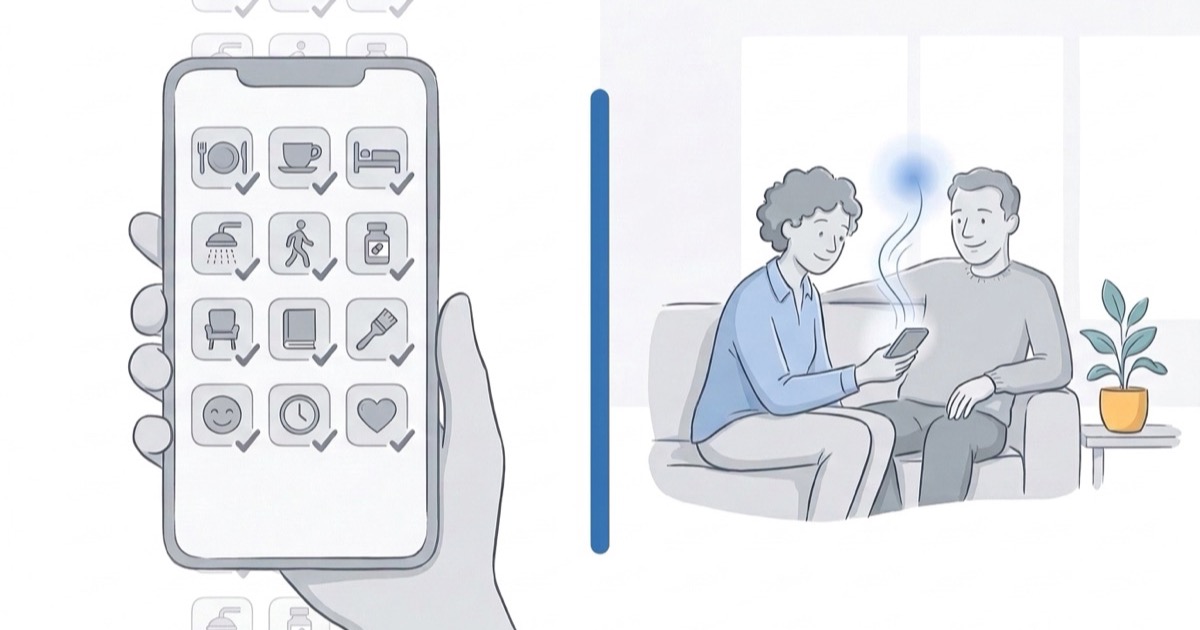
Care recording in the UK still happens in a mix of ways. Around a third of systems use an icon grid, where a support worker taps ten symbols in thirty seconds and ends up with a row of ticks. Others rely on typed free text, basic voice notes, or paper. None of them make it easy to capture what a worker actually knows about someone's day.
Leafnotes uses those same thirty seconds differently. A support worker describes the day as they would at handover, and our Lola AI organises it across five or six case note categories and drafts it in clear, well-written English. The worker checks it and saves.
Same time spent, but a real and rich picture of the person's support and day, rather than a set of ticks.
To improve social care in the UK, government, organisations and local authorities need rich data to review, learn from and act on.
Recording is only a starting point. The bigger difference is what happens beyond recording.
Shaped around your organisation
Every organisation using Leafnotes tailors its own care plans. Your accident and incident forms follow your reporting structure, not ours. If you have bespoke forms your teams already rely on, or that a commissioner asks for, we integrate them. No waiting for a feature request to travel up a roadmap.
Training rules are written per service. A children's residential home and a supported living team within the same organisation can each have their own guidance built into the system, so support workers are directed in real time towards the right way of doing things in that setting.
Many of the large, established systems approach this the other way round.
They arrive with a fixed view of how a care management system should function, and the organisation adapts its practice to fit. Configuration is limited, changes are slow, and the software becomes something teams work around rather than with.
Where the flexibility came from
This was not a principle we picked in a meeting, or a grand strategic vision, sometimes in life you get a bit of luck!
It came from who we built and co-created the entire platform with.
From day one we worked with Nugent, a 145-year-old charity providing children's services, residential care, secure units, supported living and domiciliary care across the North West.
Five very different kinds of care under one roof, each with its own forms, plans, risks and regulatory expectations.
A rigid system would have forced compromise in at least four of those five areas. So we built a fully functional platform that could hold all of them, and made sure what worked for Nugent could be reshaped for the next organisation without starting again.
The result is a consistent, well-designed customer experience on the surface, with content underneath that is able to be crafted by you.
People are used to fantastic mobile app experiences on Spotify, Photos or social media that spend millions on great experiences, so we ensured from day 1 support workers would find our mobile apps a pleasure to use, not a clunky bit of B2B software shoved onto a phone.
What this could mean for care
We are early, and we know it.
But we are excited about what a flexible system, and rich data can do for the sector.
As a starting point we hope to shift the market enough that regulators and competitors understand that clicking off icons every day is an unacceptable form of reporting on how a person received support that day.
That is the standard we are going to contribute towards for care in the UK.
Not a basic one for all system that tells you how to deliver care in a static, tick box kind of way, but one that helps you run it well, providing the best possible care to those that need it.